
How a Microtransporter releases its nutrients.
Our laboratory measured how fast two types of 2 mm pellets give up their vitamin C — and then combined those measurements with what is known about how the stomach passes material on. The result is a timeline of when a nutrient actually arrives in the intestine.
Why the timing is a question at all
The stomach is a sorting station. It does not pass everything on at the same speed: thin liquids leave quickly, small solid particles take longer, and large indigestible pieces stay behind until a cleaning wave sweeps them out between meals. Which path a nutrient takes therefore decides when it can be absorbed at all.
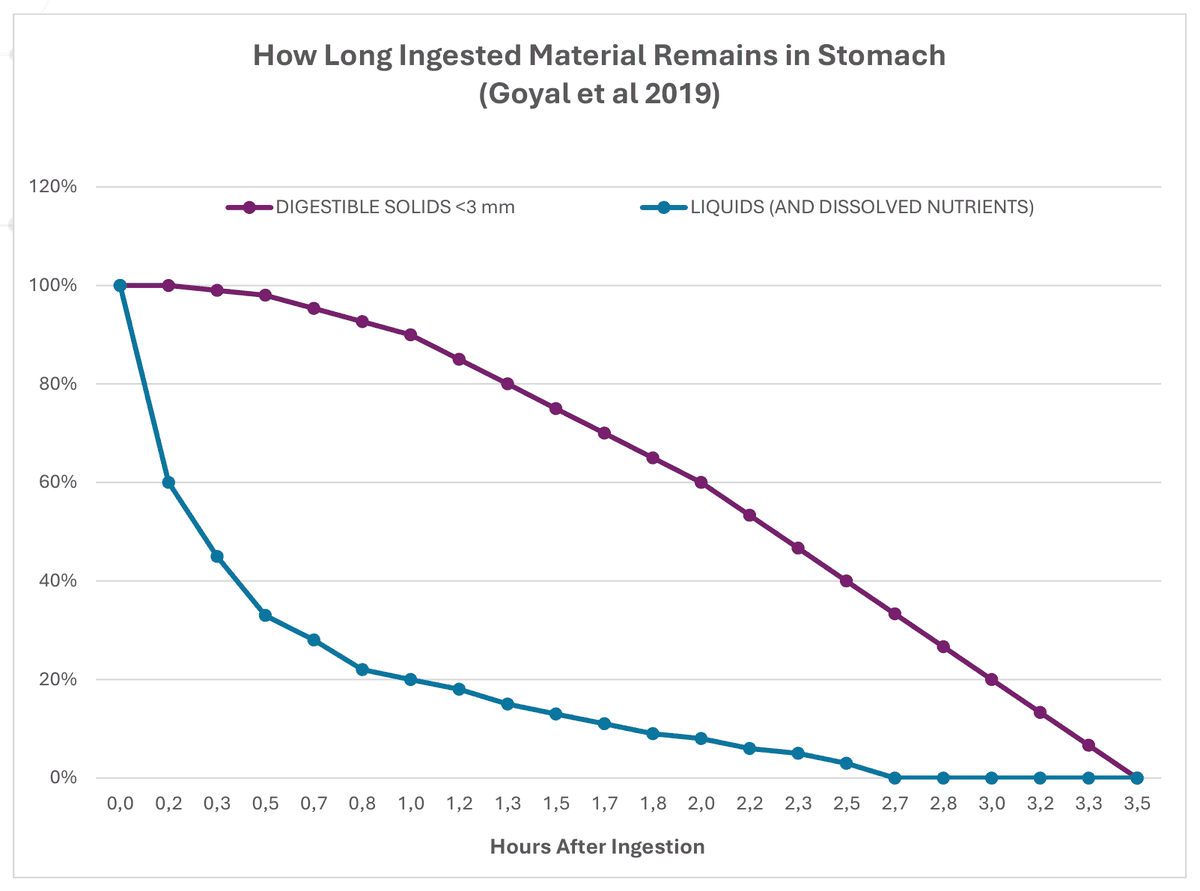
Size is the decisive criterion. Studies with human volunteers show that solid particles of up to roughly 3 mm can leave the stomach after a meal, while clearly larger pieces wait for the next cleaning wave. A pellet of 2 mm is below that threshold — which is why the study treats it as a small solid rather than as a piece that gets stuck.
What was tested
- Two pellets, same size. Both were made at 2.0 mm so that the surface available for release is comparable. Both carried vitamin C as the test nutrient.
- The fast format consists of a water-permeable matrix without an acid-resistant barrier. As soon as it gets wet, the vitamin C diffuses out.
- The slow format has an acid-resistant outer layer that keeps it closed in the stomach, plus an inner layer that controls how quickly the content can diffuse out and how fast the layer itself erodes.
- A 50:50 mixture of both pellet types was calculated as a third variant, because real formulations combine both.
- The measurement. The pellets lay in an intestinal buffer at body temperature (37 °C) with gentle stirring. Vitamin C is an acid, so as it is released it lowers the pH of the liquid. That pH was recorded continuously and converted into a percentage using a calibration curve produced by adding known amounts of vitamin C to the same buffer. Several vessels ran in parallel, over 0 to 8 hours, with the release read out in 10-minute steps.
What the pellets did in the gut model
The two formats behaved as their construction suggests, and the difference is large.
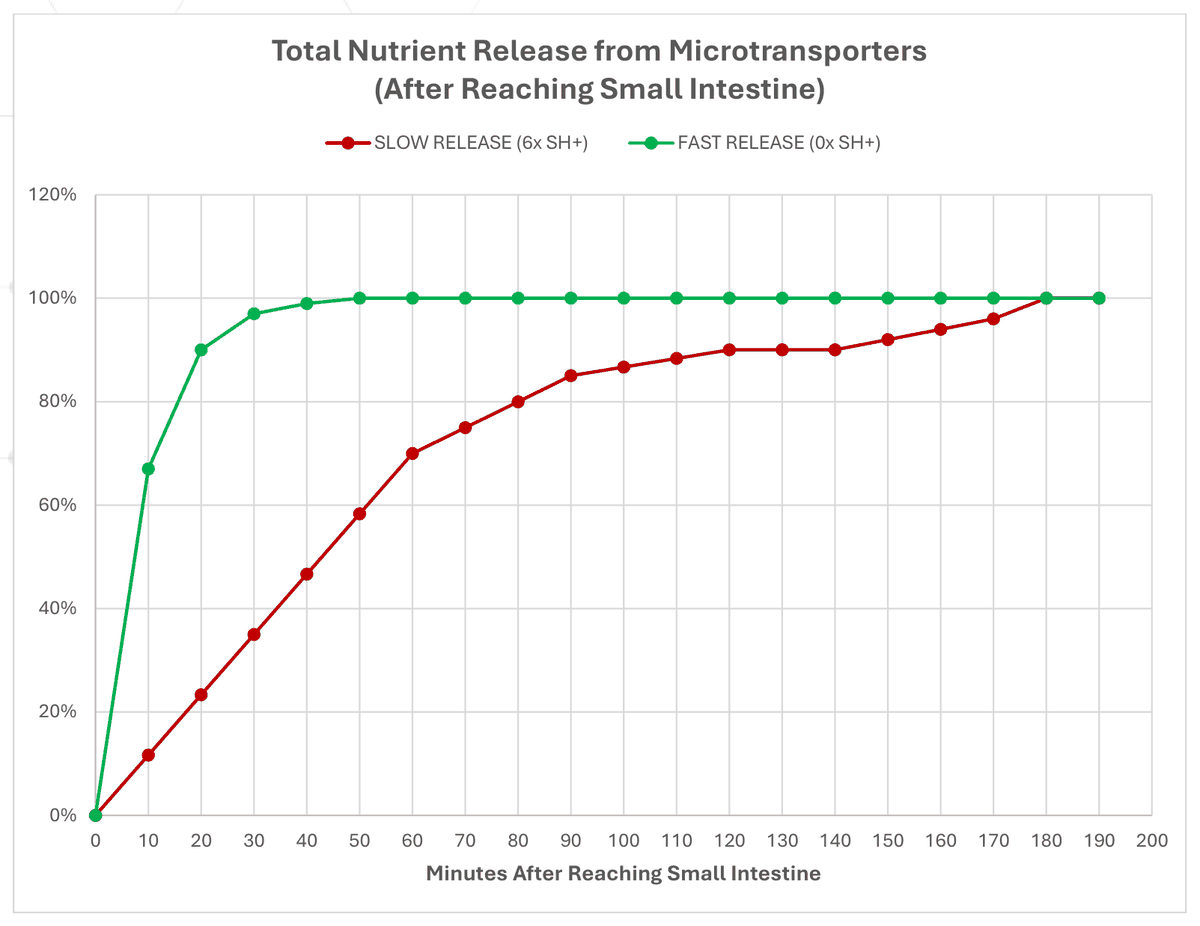
- Fast format: about 70 % of the vitamin C was out within the first 10 minutes, and after 60 minutes the pellet was practically empty. The release is concentrated in a narrow, high peak in the first 30 to 40 minutes.
- Slow format: a flat start, then a steadily rising, evenly distributed release that reaches around 100 % only after about 3 hours. Its peak is broad and low and lies between roughly 2.5 and 3.5 hours.
What that means after swallowing
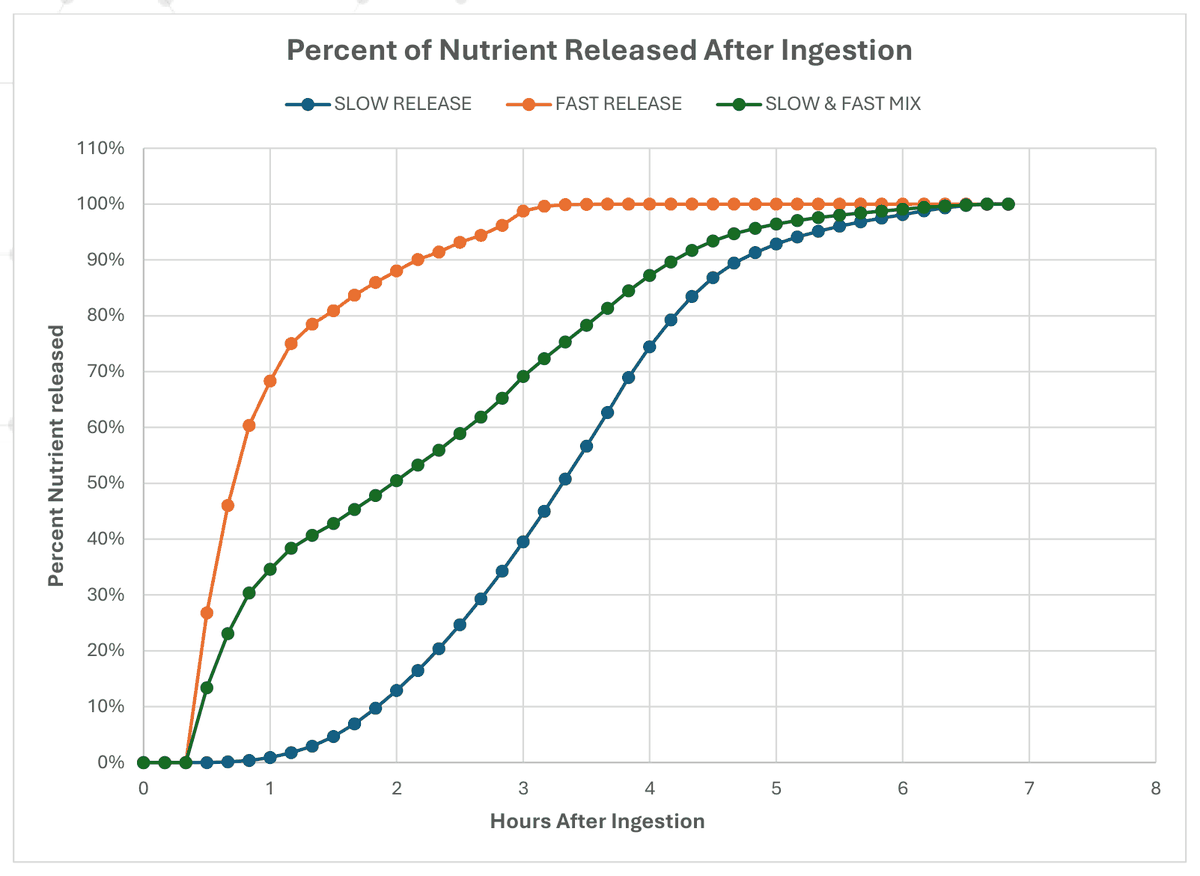
Release in a beaker is only half the answer. The second half is how long the pellet needs to get out of the stomach. For that, the study used measured values from human studies: plain liquids leave the stomach quickly — half of the water is gone after about 13 minutes — while small solids leave with a short delay over roughly 2 to 4 hours. Both curves were then laid over the measured release.
- The fast pellet dissolves early, its content travels on as part of the liquid and reaches the small intestine mostly within about 1.5 hours of swallowing. Everything happens in the first stretch.
- The slow pellet stays closed in the stomach thanks to its acid-resistant shell, moves on as a small solid and only then begins to release. That produces a delivery window of around 7 hours.
- The 50:50 mixture lies in between and keeps supplying continuously across the entire 7 hours — the quick start of the fast pellet plus the long tail of the slow one.
What this is good for
- Fast is useful where a nutrient should be available quickly, or where it is meant to arrive together with a meal.
- Slow spreads the load. Because less arrives at once, according to the study it is less likely that several nutrients compete for the same transport routes in the intestinal wall, and interactions in which nutrients oxidise each other become less likely. Absorption can also happen in later sections of the small intestine.
- The mixture comes closest to a meal. A continuous supply over several hours resembles the way nutrients become available from ordinary food.
What the study does not show
The paper names its own limits, and they belong here:
- The test liquid is a simple buffer. Media that contain bile salts and phospholipids come closer to the real small intestine. The method of laying release and stomach transport over each other stays the same, whichever liquid is used.
- The stomach values are averages from the literature. Meal size, fat and protein content and individual differences shift them — a caloric drink, for instance, slows the emptying of liquids.
- The size threshold for leaving the stomach is not a fixed line. Depending on the meal and the motion of the stomach, somewhat larger particles can also pass.
- The timelines are calculated, not measured in people. To show clinical relevance, the study itself calls for follow-up work with sampling along the intestine or with blood-level measurements.
- The pH method works because vitamin C is an acid. Non-acidic nutrients need other measurement methods; the calculation model behind it stays the same.
The study as a download
Intestinal Delivery Profiles of 2-mm Nutrient Microbeads (“Microtransporters”): In-Vitro Release Integrated with Physiological Gastric Transport
The title of the study uses the technical term “microbeads”; on our pages we call the same pellets Microtransporters.
Sources cited in the study: Abell et al., J Nucl Med Technol 2008; Goyal, Guo & Mashimo, Neurogastroenterol Motil 2019; Mudie et al., Mol Pharm 2014; Li et al., Compr Rev Food Sci Food Saf 2022; Maurer, J Nucl Med 2015; Leigh, Kloefer & Schaich, Dissolution Technol 2013; Klein, AAPS J 2010; Stotzer & Abrahamsson, Neurogastroenterol Motil 2000.
This page summarises a study from our own laboratory and serves as product and background information. It does not constitute medical advice, diagnosis or a treatment recommendation. It was prepared with the help of AI and reviewed by Novogenia.