
Folate deficiency: symptoms, causes and tests
The typical symptoms of folate deficiency are extreme tiredness, a lack of energy, a sore and red tongue, mouth ulcers, muscle weakness and changes in mood. Over time, a lack of folate can lead to anaemia with enlarged red blood cells. Because vitamin B12 deficiency causes the same complaints, only a blood test at your doctor shows what is really behind them.
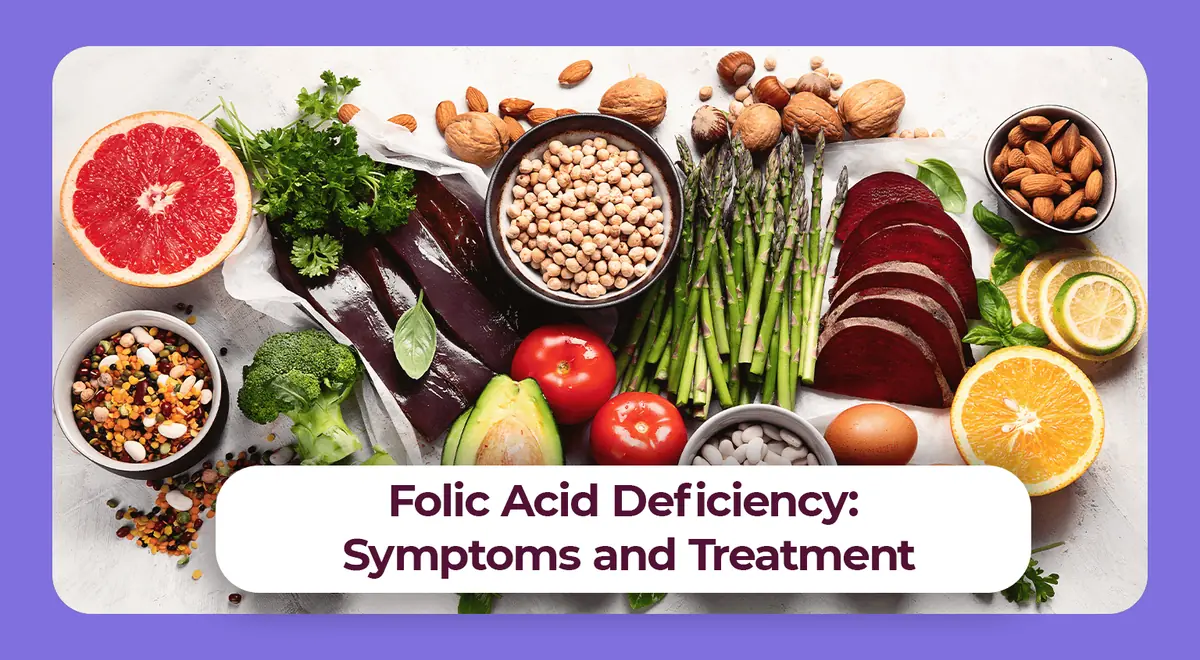
Folate deficiency at a glance
- Folate (vitamin B9) contributes to normal blood formation and has a role in the process of cell division.
- Symptoms include tiredness, a sore and red tongue, mouth ulcers and low mood. They are the same as in vitamin B12 deficiency.
- Common causes are a one-sided diet, alcohol, digestive conditions such as coeliac disease, some medicines and the higher need in pregnancy.
- Adults need 300 µg of folate equivalents a day. Women who want to become pregnant should also take 400 µg of folic acid a day.
- A suspected deficiency belongs in the hands of your doctor. A blood test confirms it.
What are the symptoms of folate deficiency?
A lack of folate develops slowly, and the first complaints are easy to overlook. The NHS lists these symptoms for folate and vitamin B12 deficiency anaemia:1
- extreme tiredness and a lack of energy
- a sore and red tongue
- mouth ulcers
- muscle weakness
- pins and needles
- problems with your vision
- changes in mood, from mild low mood or worry to confusion
- problems with memory, understanding and judgement
Some of these symptoms can appear before anaemia shows up in the blood count. Folate is needed for normal blood formation. When it runs low, the body makes fewer and larger red blood cells. Doctors call this macrocytic or megaloblastic anaemia.
Folate or vitamin B12 deficiency?
You cannot tell the two apart by the symptoms. Both vitamins work closely together, and both deficiencies lead to the same type of anaemia. That matters for treatment: folic acid can hide the changes in the blood count while a vitamin B12 deficiency continues in the background. The safety limit for folic acid is based on exactly this masking effect.2 More on this: vitamin B12 deficiency: symptoms and causes.
What causes folate deficiency?
The NHS names these causes:3
- Diet: too few folate-rich foods, an unbalanced or restrictive diet.
- Alcohol: regular heavy drinking.
- Poor absorption: digestive conditions such as coeliac disease.
- Losses through the kidneys: for example in heart failure, acute liver damage or long-term dialysis.
- Medicines: some anticonvulsants, colestyramine, sulfasalazine and methotrexate.
- Higher need: pregnancy, some blood disorders such as sickle cell anaemia, infections and inflammation.
- Premature birth: babies born before 37 weeks.
How well supplied with folate are people in Germany?
Many fall just short of the recommendation. In the German National Nutrition Survey II, the median intake was 252 µg a day for women and 283 µg for men.4 Both are below the recommended 300 µg. Legumes and green vegetables close this gap fastest (see the table below).
Rare inherited causes
Very rarely, a gene defect blocks the uptake of folate from the gut. This hereditary folate malabsorption is inherited in an autosomal recessive way and shows up in infancy.
How is folate deficiency diagnosed?
Your doctor can usually recognise it from your symptoms and a blood test.1 The blood count shows whether there is anaemia with enlarged red blood cells, and the folate level in the blood shows whether folate is low. Vitamin B12 is checked at the same time, because both deficiencies look alike.
What should you do if you suspect a deficiency?
See your doctor and have your blood checked before you take high-dose supplements. Your doctor finds the cause and decides on treatment. Taking folic acid on your own can hide a vitamin B12 deficiency.2
For supplements, the German Federal Institute for Risk Assessment (BfR) recommends at most 200 µg of folic acid per daily dose, or 400 µg in products for women who want to become pregnant.2 The EFSA upper level for added folic acid is 1,000 µg a day for adults.5 Folate from normal food does not count towards it. More on limits: how we set dosing limits for micronutrients.
How much folate do you need per day?
From the age of 13, the German, Austrian and Swiss nutrition societies (D-A-CH) recommend 300 µg of folate equivalents a day. Pregnant women need 550 µg, breastfeeding women 450 µg.6 Women who want to become pregnant should also take 400 µg of folic acid a day, starting at least 4 weeks before pregnancy and continuing through the first third of it.6 Full table by age: folic acid: effects and daily requirement. Everything about pregnancy: folic acid in pregnancy.
Which foods are high in folate?
Legumes, liver and green vegetables contain the most folate per serving.
| Food | µg DFE per 100 g | Serving | µg DFE per serving |
|---|---|---|---|
| Chicken liver, cooked | 578 | 85 g (3 oz) | 491 |
| Edamame, cooked | 311 | 155 g (1 cup) | 482 |
| Lentils, cooked | 181 | 198 g (1 cup) | 358 |
| Mung beans, cooked | 159 | 202 g (1 cup) | 321 |
| Pinto beans, cooked | 172 | 171 g (1 cup) | 294 |
| Chickpeas, cooked | 172 | 164 g (1 cup) | 282 |
| Spinach, cooked | 146 | 180 g (1 cup) | 263 |
| Black beans, cooked | 149 | 172 g (1 cup) | 256 |
| Kidney beans, cooked | 130 | 177 g (1 cup) | 230 |
| Beef liver, cooked | 253 | 85 g (3 oz) | 215 |
Source: USDA FoodData Central, SR Legacy, folate as µg dietary folate equivalents (DFE), retrieved 23 November 2026. Legumes and vegetables are listed cooked. Serving sizes follow the USDA portion data. Full table with 25 foods: folic acid: daily requirement and foods.
Liver is very rich in folate but also in vitamin A, so pregnant women are advised to avoid it.7
Folate and your genes
Your body has to convert folic acid into its active form before it can use it. A very common variant of the MTHFR gene slows this step down. How this works is explained in our Gene Story folic acid and the MTHFR gene.
Sources
- NHS: Vitamin B12 or folate deficiency anaemia, overview and symptoms. nhs.uk (retrieved 23 November 2026).
- Bundesinstitut für Risikobewertung (BfR): Aktualisierung (2024) Höchstmengenvorschläge für Folsäure in Lebensmitteln inklusive Nahrungsergänzungsmitteln, opinion of 22 February 2024. bfr.bund.de (PDF)
- NHS: Vitamin B12 or folate deficiency anaemia, causes. nhs.uk (retrieved 23 November 2026).
- Max Rubner-Institut: Nationale Verzehrsstudie II, Ergebnisbericht Teil 2 (2008). mri.bund.de (PDF)
- EFSA: Overview on Tolerable Upper Intake Levels, folate (EFSA NDA Panel 2023). efsa.europa.eu (PDF)
- Deutsche Gesellschaft für Ernährung (DGE): Referenzwerte Folat (D-A-CH, Stand Ableitung 2015). dge.de (retrieved 23 November 2026).
- Bundesinstitut für Risikobewertung (BfR): Schwangere sollten weiterhin auf den Verzehr von Leber verzichten (1995). bfr.bund.de
Important to know
If you are not a medical specialist and have complaints, specific health conditions, or suspect deficiencies, please make sure to consult a doctor to discuss this.
Frequently asked questions
What are the first signs of folate deficiency?
What is the difference between folate and folic acid?
How long does it take to correct a folate deficiency?
Who is most at risk of folate deficiency?
Can folate deficiency affect your mood?
Which foods help against low folate?
Want to know how your genes handle folate? Our partners offer a genetic analysis from a saliva sample. In the nutrient formula calculated from it, folic acid stays between 66.7 and 600 µg a day, below the EFSA upper level of 1,000 µg.
»How a personalised nutrient formula is calculated« →Want this for yourself?
We sell our products exclusively through partner companies. We are happy to receive your inquiry and establish contact with a suitable partner company in your area.
Send an inquiry →Publisher: Novogenia GmbH – certified genetic laboratory in Eugendorf near Salzburg, since 2009. About us · Founder Dr. Daniel Wallerstorfer