
Microtransporters: tested and measured.
Microtransporters are tiny beads, 1.6 mm and up, and each one carries a single nutrient. We mix them into a daily dose made for one person. Their design decides when each nutrient is released. Here is what we measured and how we check every pack.
What Microtransporters can do
- One nutrient per bead. Because each bead carries only one nutrient, we can raise, lower or leave out every nutrient on its own, in small steps. That is how we make a formula for exactly one person, from a single unit.
- Fast or sustained release. Fast-release Microtransporters let go of their nutrient straight away. Sustained-release Microtransporters have a coating that stays closed in the stomach. They release their content in the gut, over several hours. Vitamin C then arrives in small amounts, much like eating vitamin C-rich foods throughout the day.
- Kept apart in time. Calcium and zinc can get in each other's way during uptake. So zinc is released right away and calcium hours later, once the beads are further along in the gut.
- One sachet a day. The beads are small enough for a whole day's formula to fit into one sachet. You take everything once a day.
What we measured
We tested both types with vitamin C in our laboratory. The beads sat in intestinal fluid at 37 °C, body temperature, and we measured how much vitamin C came out over time.
The fast-release Microtransporters released about 70% in the first 10 minutes and were practically empty after an hour. The sustained-release ones started slowly and released their vitamin C evenly over about 3 hours.
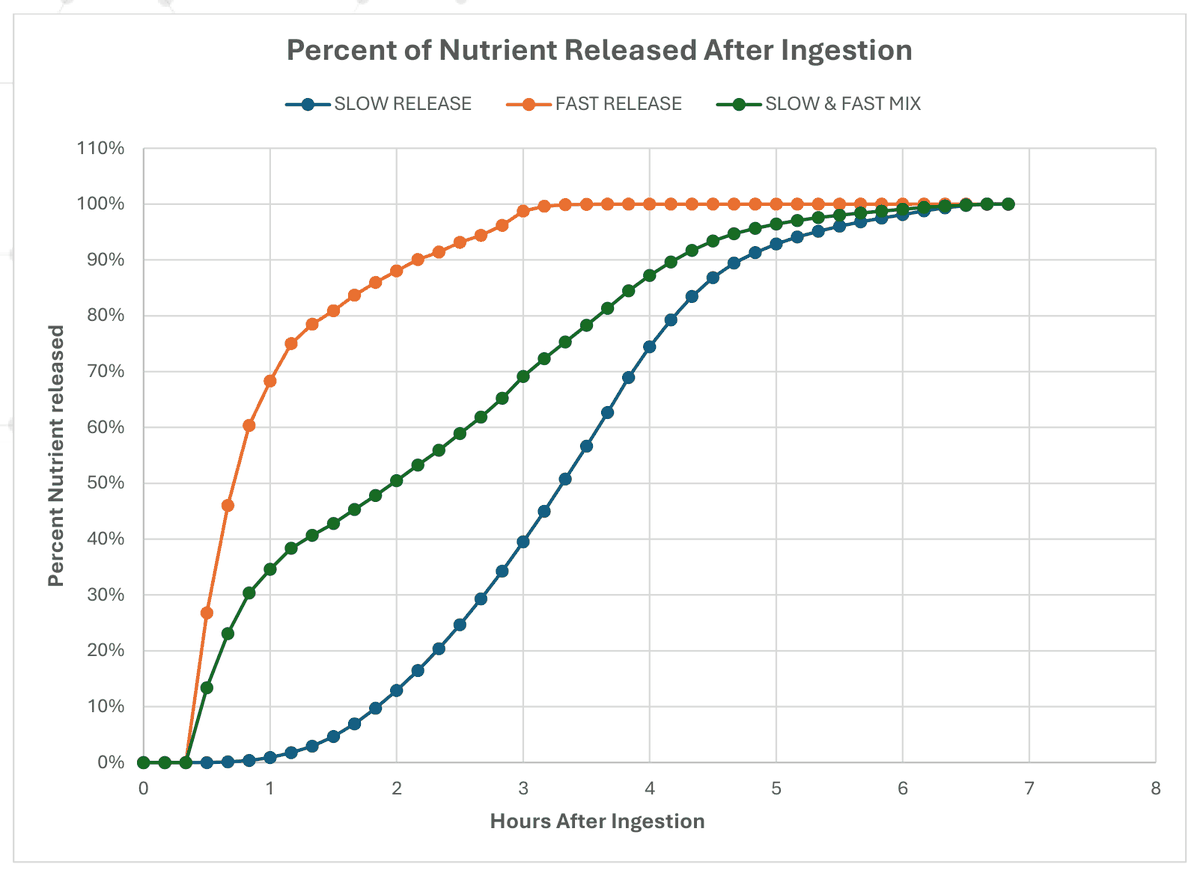
In the body, the beads first have to pass through the stomach. So we combined our measurement with data from human studies on gastric emptying. On that basis, the fast-release Microtransporters deliver most of their nutrient within 1.5 hours of taking them. The sustained-release ones spread it over about 7 hours. A 50:50 mix delivers nutrients steadily over the whole 7 hours.
| Feature | Fast release | Sustained release |
|---|---|---|
| Design | core that lets water in | coating that stays closed in the stomach, with a layer underneath that slows the release |
| Released after 10 minutes in the lab test | about 70% | little, release starts slowly |
| Fully released in the lab test | after about 1 hour | after about 3 hours |
| Release after taking them (modelled) | mostly within the first 1.5 hours | spread over about 7 hours |
How we check every pack
The authorities give food supplements a lot of leeway. They check them against the European Commission's guidance on tolerances for nutrition labelling (December 2012). Under it, a vitamin may be 20% below or 50% above the amount on the label. If the label says 100 mg of vitamin C, anything from 80 to 150 mg passes an inspection. For a personal dose, that is far too rough.
In our best measurements, the content of a sachet was only about 2% off its label, also from one daily sachet to the next. To get there, we test at four points:
- the raw material powders of every new supplier,
- every raw material batch,
- every batch of Microtransporters,
- the finished product.
Depending on the formula, that adds up to as many as about 200 checks behind a single pack, and we can trace every one of them. EFSA's tolerable upper intake levels set the ceiling for every nutrient. Dr. Daniel Wallerstorfer explains how a formula is made in the interview.
Read the study
The original study is in the open research repository Zenodo, with a DOI and under a CC BY 4.0 licence. You can read, download and cite it there.
Intestinal Delivery Profiles of 2-mm Nutrient Microbeads (“Microtransporters”): In-Vitro Release Integrated with Physiological Gastric Transport
How to cite: Reither D., Gruber A., Huttegger M., Wallerstorfer D. (2025): Intestinal Delivery Profiles of 2-mm Nutrient Microbeads (“Microtransporters”): In-Vitro Release Integrated with Physiological Gastric Transport. Zenodo. https://doi.org/10.5281/zenodo.24526992
What the study does not show
- We measured the release in the laboratory. The times after taking them are modelled, not measured in people.
- The gastric emptying figures are averages from the literature. The size and makeup of a meal shift them.
- The study shows when a nutrient is released. It says nothing about effects in the body.
All details, limitations and sources are in the full summary of the study.
Read on
This page summarises measurements from our own laboratory and is meant as product and background information. It is not medical advice, diagnosis or a treatment recommendation. Food supplements do not replace a varied, balanced diet and a healthy lifestyle. Our products are available through our partner companies. This page was created with the help of AI and reviewed by Novogenia. Who writes here and where the sources come from.